
· Hugo · Customizing · 5 min read
Why Are Bicycles So Expensive? (Complete Cost Breakdown)
You're shopping for a bicycle and the prices shock you. A basic bike costs $400–$700. Mid-range bikes easily run $2,000–$4,000. High-end models? $10,000 or more. This guide breaks down where your money goes — and whether expensive bikes are truly worth it.
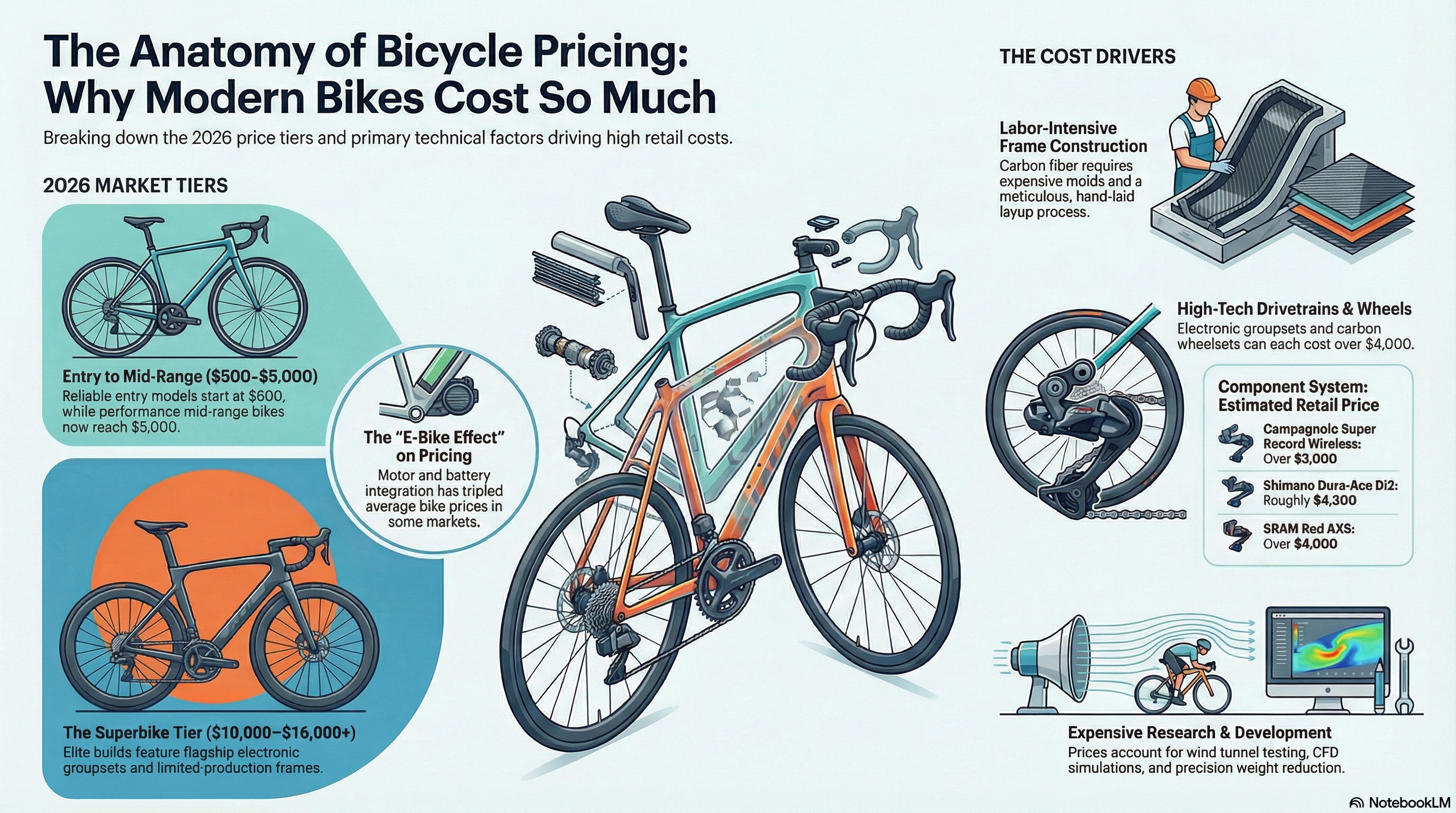
You’re shopping for a bicycle and the prices shock you. A basic bike costs $400–$700. Mid-range bikes easily run $2,000–$4,000. High-end models? $10,000 or more.
So what’s actually going on?
The real answer comes down to materials, components, manufacturing complexity, research and development, distribution, and retail margins. Once you understand how pricing works, the numbers start to make sense.
This guide breaks down where your money goes — and whether expensive bikes are truly worth it.
Bicycle Price Ranges in 2026
Bike pricing has shifted upward in recent years. According to BikeRadar’s 2026 buyer’s guides, what used to be considered “mid-range” is now entry-level performance territory.
Here’s what modern tiers look like:
Entry-Level: $500–$1,000
You can technically start road cycling around $350–$500, but most high-quality entry-level bikes now sit in the $500–$1,000 range. These are reliable, durable, and suitable for regular riding.
Mid-Range: $3,000–$5,000
This tier used to represent high-end bikes. Now it typically includes better frame materials, upgraded drivetrains, and lighter wheelsets aimed at performance-oriented riders.
High-End: $5,000+
Premium carbon frames, advanced aerodynamics, electronic shifting systems, and high-performance components dominate this category.
Premium / “Superbike” Tier: $10,000–$16,000+
Top-tier builds featuring flagship groupsets like Shimano Dura-Ace Di2, SRAM Red AXS, or Campagnolo Super Record Wireless. Some limited-production models exceed $15,000.
Where Your Money Goes
While exact percentages vary, industry market reports consistently show that the majority of a bike’s MSRP comes from three main areas:
- Frame
- Drivetrain (groupset)
- Wheels
Let’s break it down.
1. The Frame (Often the Largest Cost)
The frame is the backbone of the bicycle. It determines weight, stiffness, ride feel, and durability.
Material Differences
Industry research reports show that material and personnel costs are the largest cost blocks for manufacturers.
- Aluminum – Most affordable and widely used.
- Steel – Classic ride feel, lower material cost but more labor-intensive.
- Carbon Fiber – High strength-to-weight ratio, expensive raw material, labor-intensive layup process.
- Titanium – Difficult to work with and considered a major investment material.
Carbon fiber frames require expensive molds, hand-laid construction, and extensive quality control. That alone can drive prices into the thousands.
Tariffs and supply chain shifts have also played a role. Consulting firm Roland Berger reported that European brands have had to rethink sourcing and production between 2023–2026 due to industry downturns and tariff pressure.
2. Components / Drivetrain (The “Groupset”)
The drivetrain includes:
- Shifters
- Derailleurs
- Cassette
- Chain
- Crankset
- Brakes
High-end electronic groupsets dramatically increase pricing.
Retail pricing examples in 2026:
- Shimano Ultegra Di2: around $2,400
- Shimano Dura-Ace Di2: roughly $4,300
- SRAM Force AXS: about $2,100–$2,200
- SRAM Red AXS: about $4,000+
- Campagnolo Super Record Wireless: over $5,000
That’s just the drivetrain — not the entire bike.
Precision machining, advanced materials (titanium, carbon), and integrated electronics push costs higher.
3. Wheels
Wheels can make or break performance.
High-end carbon wheelsets can retail between $2,800 and $4,000+. Even mid-range carbon wheels often exceed $1,500.
Cost drivers include:
- Carbon rim construction
- Hub precision and bearing quality
- Aerodynamic shaping
- Hand assembly
Premium wheels alone can represent a significant portion of a bike’s total cost.
4. Smaller Components
Even “small” parts add up:
- Saddles: $30–$300+
- Handlebars & stems: $50–$500+
- Tires: $50–$200+ per pair
- Pedals: $20–$300+
When brands spec premium versions of these across an entire build, costs stack quickly.
5. Labor & Assembly
Bikes are not fully automated products.
Manufacturing includes:
- Frame welding or carbon layup
- Component installation
- Quality control
- Final assembly
Retail shops then assemble, tune, and inspect bikes before sale. Labor is built into the final price.
6. Research & Development
Modern performance bikes undergo:
- Wind tunnel testing
- Computational fluid dynamics simulations
- Material stress testing
- Prototyping and ride testing
Those R&D costs must be recovered across product lines.
7. Brand & Retail Margin
A significant portion of MSRP goes toward:
- Marketing
- Sponsorships
- Distribution
- Inventory holding costs
- Bike shop overhead
Between 2023 and 2025, the industry faced what analysts call a “bullwhip effect” — excess inventory caused heavy discounting. Reports show many brands offered 25–47% discounts to clear stock.
That pressure squeezed margins and forced brands to simplify product lines and reduce SKU counts going into 2026.
Why High-End Bikes Cost So Much
High-end pricing is usually driven by:
1. Carbon Fiber Engineering
More complex layups and lighter frames require more labor and tighter tolerances.
2. Electronic Shifting
Systems like Di2 and AXS require batteries, wiring, firmware, and high-precision parts.
3. Weight Reduction
Shaving grams gets exponentially more expensive.
4. Limited Production
Smaller production runs mean fewer economies of scale.
The E-Bike Effect
Electrification has dramatically shifted average bike prices.
Industry data shows that in some European markets, average bike prices have tripled over the past decade due to motor and battery integration.
E-bikes include:
- Motor systems
- Battery packs
- Reinforced frames
- Stronger wheels
- Higher torque-rated components
All of this pushes overall industry pricing upward.
Are Expensive Bikes Worth It?
It depends.
They make sense if you:
- Race or ride competitively
- Care about weight and aerodynamics
- Ride frequently and long distances
- Plan to keep the bike long-term
Budget bikes are fine if you:
- Ride casually
- Commute short distances
- Are just getting started
- Want good value without chasing marginal gains
For most recreational riders, a well-chosen $1,000–$3,000 bike delivers excellent performance.
How to Get Better Value
1. Buy During Inventory Cycles
Recent years have seen unusually deep discounts due to industry overstock — often 25–40% off MSRP.
2. Buy Previous Model Years
Specs often remain similar while pricing drops significantly.
3. Consider Used
High-end bikes depreciate quickly.
4. Avoid Over-Spec’ing
Many riders won’t benefit from the jump between mid-tier and flagship components.
Summary: Why Bicycles Cost So Much
Bicycles are expensive because they combine:
- Advanced materials
- Precision components
- Labor-intensive manufacturing
- Ongoing R&D
- Brand and retail overhead
In 2026, pricing is also influenced by supply chain shifts, tariff changes, and the continued rise of e-bikes.
The key takeaway?
Buy based on how you ride — not just what looks impressive on paper.
For many cyclists, smart mid-range builds deliver 90% of the performance at a fraction of the cost.
Why Are Bicycles So Expensive? (FAQ)
Why are bicycles so expensive?
Bicycles cost more due to materials (carbon, titanium), precision components (groupsets, wheels), labor-intensive manufacturing, R&D, and retail margins. Frame, drivetrain, and wheels typically account for most of the MSRP. Tariffs and supply chain shifts have also pushed prices up.
Why are some bicycles so expensive?
High-end bikes use carbon fiber frames (expensive molds, hand-laid construction), flagship groupsets (electronic shifting, lightweight materials), and premium wheels. Limited production runs and brand positioning also drive prices into the $10,000+ range.