
· Hugo · Bikes · 5 min read
Who and When Was the Bicycle Invented? (Complete History)
The bicycle wasn't invented by a single person on a single day. It evolved over nearly 70 years through multiple inventors, each solving a different problem — balance, propulsion, gearing, safety, and comfort. Learn the complete history from the draisine to the safety bicycle.
Who invented the bicycle?
The honest answer: no single person did.
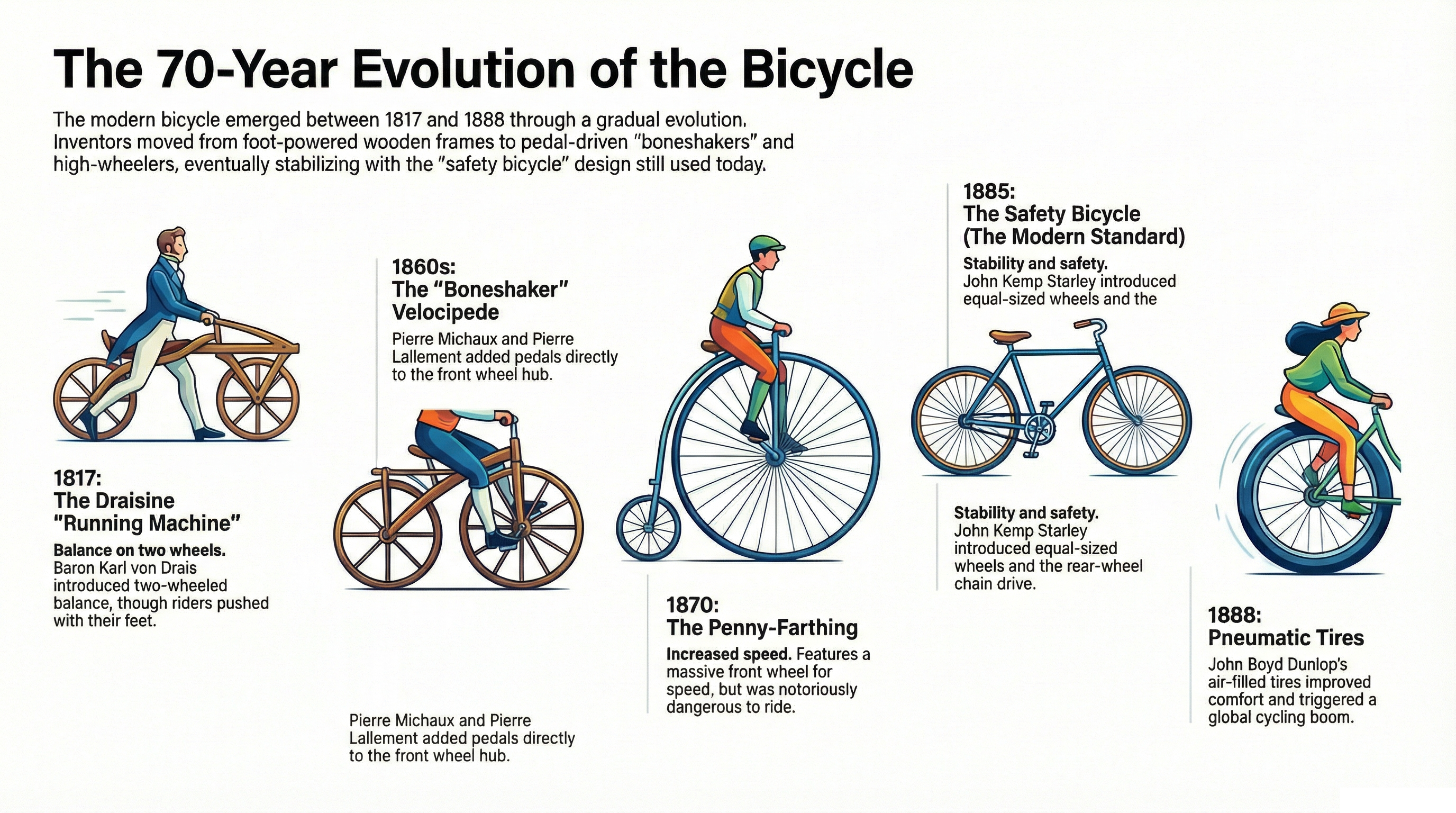
The bicycle wasn’t created in one breakthrough moment. Instead, it evolved over nearly 70 years through multiple inventors, each solving a different problem — balance, propulsion, gearing, safety, and comfort.
The modern bicycle we ride today is the result of gradual innovation that began in the early 1800s and stabilized in the 1880s with the invention of the “safety bicycle.”
Let’s trace that evolution.
1817: The First Two-Wheeled Machine (The Draisine)
The story begins in 1817 with a German inventor named Baron Karl von Drais.
In Mannheim, Germany, Drais unveiled what he called the Laufmaschine — or “running machine.” It later became known as the draisine.
What It Looked Like:
- Two wheels aligned front to back
- A wooden frame
- A seat
- A basic handlebar for steering
- No pedals
Riders pushed themselves forward with their feet against the ground — essentially gliding between steps.
Historians widely credit Drais’ 1817 public demonstration as the first successful human-powered two-wheeled vehicle. It wasn’t a bicycle yet, but it introduced the essential idea: balance on two inline wheels.
That concept changed everything.
1860s: The First Pedal Bicycle (The Velocipede)
The next major leap happened about 40 years later: someone added pedals.
Between 1861 and 1863, French inventors began attaching cranks and pedals directly to the front wheel.
Two names are most commonly associated with this breakthrough:
- Pierre Michaux (France), who is often credited with commercializing the pedal design around 1861
- Pierre Lallement, who independently built a pedal-driven prototype in 1863 and later received a U.S. patent in 1866
This machine became known as the velocipede — or more memorably, the “boneshaker.”
Why “Boneshaker”?
- Wooden or iron frame
- Iron-banded wheels
- No suspension
- Cobblestone roads
The ride was brutally rough.
But this was the first true pedal-powered bicycle, marking the transition from foot propulsion to mechanical drive.
1870: The High-Wheeler (Penny-Farthing)
Speed was the next challenge.
To go faster without gears, inventors increased wheel size. Because pedals were fixed directly to the front hub, a larger wheel meant more distance traveled per rotation.
In 1870, James Starley and William Hillman introduced the famous high-wheel bicycle, marketed as the Ariel.
It became known as the penny-farthing, named after two British coins — one large, one small.
Features:
- Massive front wheel (sometimes 5 feet tall)
- Tiny rear wheel
- Direct drive (pedals attached to front hub)
- No effective braking system
It was faster than anything before it.
It was also dangerous.
Riders sat high above the front axle, and sudden stops often sent them flipping forward — a crash known as a “header.”
The penny-farthing was impressive, but it wasn’t practical or safe for most people.
That problem led to the most important breakthrough in bicycle history.
1885: The Safety Bicycle (The Modern Design)
In 1885, John Kemp Starley, nephew of James Starley, introduced the design that changed cycling forever.
His invention, the Rover Safety Bicycle, featured:
- Two equal-sized wheels
- A chain drive powering the rear wheel
- A lower center of gravity
- A diamond-shaped frame
This configuration solved nearly every problem of earlier designs.
Chain drive meant speed no longer required a giant wheel.
Equal wheel size improved stability.
The diamond frame provided strength with less material.
Modern historians consider the 1885 Rover to be the first true example of the modern bicycle.
And remarkably — the basic structure hasn’t changed much since.
1888: Pneumatic Tires Transform Comfort
Even with the safety bicycle, rides were still rough.
In 1888, Scottish inventor John Boyd Dunlop introduced the pneumatic (air-filled) tire, originally developed to make his son’s tricycle more comfortable.
The impact was enormous.
Air-filled tires:
- Improved comfort
- Increased speed
- Reduced vibration
- Made long-distance riding realistic
This innovation triggered the bicycle boom of the 1890s.
The 1890s Bicycle Boom
Once the safety bicycle and pneumatic tires combined, cycling exploded in popularity.
Mass production techniques lowered prices. Standardized designs increased reliability.
By the 1890s:
- Bicycles became affordable to the middle class
- Cycling clubs spread across Europe and America
- Women adopted cycling in large numbers
- Roads began improving to accommodate riders
The bicycle became more than a machine — it became a social force.
Timeline of Bicycle Evolution
Timeline of Bicycle Evolution
| Year | Innovation | Key Figure |
|---|---|---|
| 1817 | Draisine (running machine) | Karl von Drais |
| 1861–1863 | Pedal-powered velocipede | Pierre Michaux / Pierre Lallement |
| 1866 | U.S. patent for pedal bicycle | Pierre Lallement |
| 1870 | Penny-farthing (Ariel) | James Starley & William Hillman |
| 1885 | Safety bicycle (Rover) | John Kemp Starley |
| 1888 | Pneumatic tire | John Boyd Dunlop |
| 1890s | Mass production & cycling boom | Industrial manufacturers |
The Modern Bicycle
Today’s bicycles still use the 1885 safety bicycle architecture:
- Two equal-sized wheels
- Rear-wheel chain drive
- Diamond frame geometry
What’s changed?
- Materials: Aluminum, carbon fiber, titanium
- Gearing systems: Multi-speed drivetrains
- Brakes: Disc brakes, hydraulic systems
- Suspension: Mountain bike shock systems
- Electric motors: E-bikes
But structurally, the modern road bike is still a direct descendant of Starley’s Rover.
Who Really Invented the Bicycle?
The most accurate answer:
The bicycle was not invented by one person.
It evolved through stages:
- Karl von Drais (1817) — invented the first two-wheeled balancing machine
- Pierre Michaux & Pierre Lallement (1860s) — introduced pedal power
- James Starley (1870) — developed the high-wheel performance era
- John Kemp Starley (1885) — created the modern safety bicycle
- John Boyd Dunlop (1888) — added pneumatic tires
Each solved a different engineering challenge.
Together, they created the bicycle.
How the Bicycle Changed Society
The bicycle had enormous impact:
- Affordable personal mobility
- Greater independence for women
- Growth of suburban travel
- Improved road infrastructure
- Influence on automobile design
Historians often argue that the bicycle directly influenced early car development — especially steering systems and chain drive mechanisms.
Summary: Evolution, Not a Single Invention
The bicycle wasn’t invented in one moment.
It evolved from:
- A wooden running machine in 1817
- To pedal-powered velocipedes in the 1860s
- To towering penny-farthings in the 1870s
- To the safety bicycle in 1885
- And finally to the comfortable, mass-produced machines of the 1890s
The modern bicycle is the product of decades of experimentation, refinement, and engineering breakthroughs.
And despite carbon fiber frames and electronic shifting, its core design is still rooted in 19th-century innovation.
Who and When Was the Bicycle Invented? (FAQ)
Who and when was the bicycle invented?
The bicycle wasn't invented by one person on one day. It evolved over nearly 70 years: Karl von Drais built the first two-wheeled machine in 1817; Pierre Michaux and Pierre Lallement added pedals in the 1860s; James Starley created the penny-farthing in 1870; John Kemp Starley introduced the modern safety bicycle in 1885; and John Boyd Dunlop added pneumatic tires in 1888.