
· Hugo · Cycling · 2 min read
Can You Inflate a Car Tire With a Bicycle Pump? (Yes - Here is How)
Got a flat car tire and no air compressor? You might be surprised to learn that your standard bicycle floor pump can save the day. Here is how to do it safely.
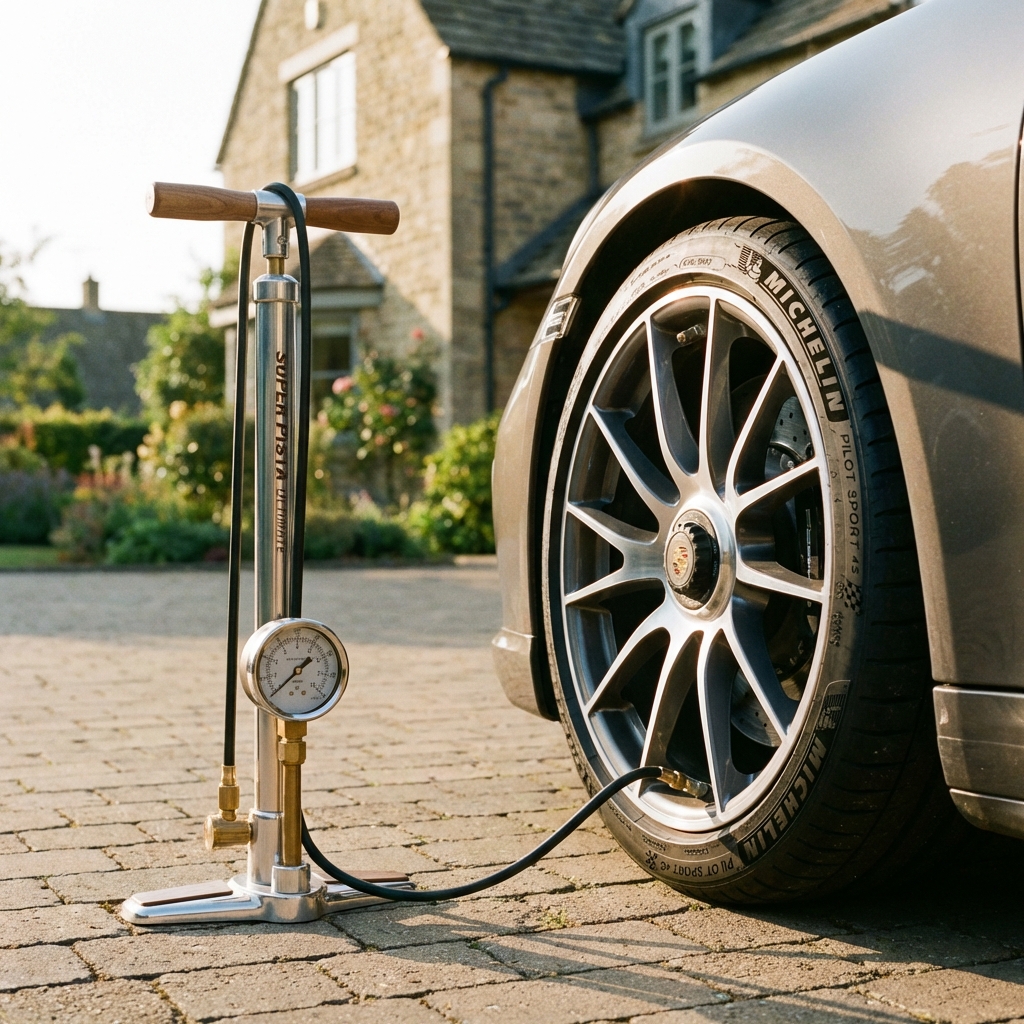
You walk out to your car in the morning and notice one of the tires is looking dangerously low. You don’t have a portable compressor, and the nearest gas station is miles away.
Then you see it: your trusty bicycle floor pump leaning in the corner of the garage.
Can you actually use a bicycle pump to inflate a car tire?
The short answer is Yes. In fact, in some ways, a bicycle pump is more capable of inflating a car tire than a car pump is of inflating a high-pressure road bike tire.
In this guide, I’ll explain the physics of why this works, why it’s a workout, and the step-by-step process to do it safely.
Why it Works: Schrader vs. Presta
Most modern cars use Schrader valves—the exact same thick, rugged valves found on mountain bikes and kids’ bikes.
Because the valve is the same, your bicycle pump head will lock onto your car’s tire valve without any adapters. Even better, a car tire usually only requires 30-35 PSI, while a bicycle pump is designed to reach 100-120 PSI. The pump has plenty of “strength”; it just lacks “volume.”
The Reality Check: Bring Your Muscles
While a bike pump has the pressure capacity, a car tire has a massive volume of air compared to a bike tire.
- Bicycle Tire: ~5-10 large pumps to change pressure by 10 PSI.
- Car Tire: ~50-100 large pumps to change pressure by just 1-2 PSI.
If you are trying to inflate a car tire from 0 to 32 PSI, expect to be pumping for 15-20 minutes and burning some serious calories. However, if you just need to top off a tire from 28 to 32 PSI, it’s a perfectly viable 5-minute task.
Step-by-Step Guide
- Check the Valve: Remove the plastic dust cap from your car tire.
- Attach the Pump: Press the bicycle pump head firmly onto the valve. Flip the locking lever. You should hear a tiny “hiss” which stops once it’s locked.
- Read the Gauge: Most floor pumps have a built-in gauge. Note the current pressure.
- Start Pumping: Use long, full strokes. Use your body weight on the way down to save your arms.
- Monitor Progress: Check the gauge every 50 pumps. It will move slowly!
- Safety First: Do not exceed the “Max PSI” listed on your car tire’s sidewall (usually around 44-50 PSI). Most cars want 32-35 PSI.
Pros and Cons
Bike Pump for Cars: Comparison
| Pros | Cons |
|---|---|
| Zero cost / No electricity needed | Extremely physically demanding |
| Highly accurate gauge on most floor pumps | Very slow (1+ PSI per minute) |
| Available in emergencies | Hard on the pump's internal seals if done often |
| Fits perfectly (Schrader valves) | Not practical for 0-PSI punctures |
Emergency Tire Inflation FAQ
How does a bicycle pump work?
A bicycle pump forces air through a hose into a tire valve. Floor pumps use a piston and handle; mini pumps use a smaller piston. The pump head locks onto Schrader (car-type) or Presta (road bike) valves. For bike-specific use, see [How to Use a Bicycle Pump](/how-to-use-bicycle-pump/).
Will this damage my bike pump?
If you do it occasionally, no. However, pumping a car tire creates a lot of heat due to friction. If the pump barrel feels hot to the touch, stop and let it cool for 5 minutes so you don't melt the internal rubber seals.
Can I use a mini-pump (hand pump)?
Technically yes, but it is deeply impractical. You would likely need 1,000+ strokes to see a meaningful change in pressure. Only attempt this in a life-or-death emergency.
Where can I find the correct PSI for my car?
Check the sticker inside the driver's side door jamb. It lists the 'Cold Tire Pressure' recommended by the manufacturer.