
· Daniel · Cycling · 6 min read
2.4 vs 2.6 MTB Tires: Which One Should You Choose?
When it comes to mountain bikes, the tires are a crucial component that can make a big difference in overall performance and ride quality.
When it comes to mountain bikes, the tires are a crucial component that can make a big difference in overall performance and ride quality.
If you are in the market for new mountain bike tires, you might be wondering if you should go for 2.4 or 2.6 width, since both are pretty common among mountain bikers.
Despite the small size difference between them, the width you choose can actually have a pretty big impact on your ride!
In this article, I’ll break down the differences between 2.4 vs 2.6 MTB tires and help you decide which one is the best for your needs.
2.4 vs 2.6 MTB Tires
The main difference between 2.4 and 2.6 MTB tires is that 2.4-inch tires offer a good balance of weight, rolling resistance, and grip, and are best for cross-country and trail riders.
With a narrower profile, they are lighter and faster than wider tires, making them ideal for riders who prioritize speed and efficiency.
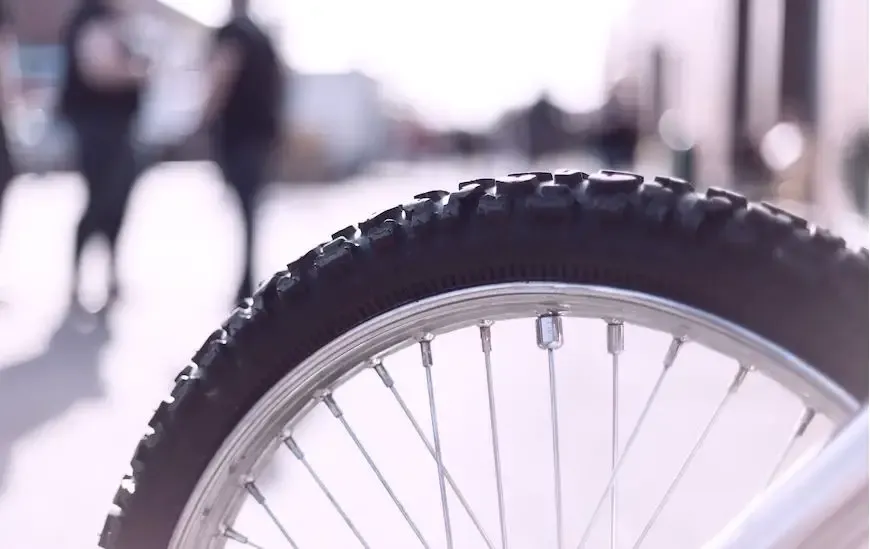
However, they may not provide as much traction and stability as wider tires, especially in loose or muddy conditions.
On the other hand, 2.6-inch tires give you more grip and control. With a wider profile, they offer more surface area and volume, allowing for lower tire pressure and better traction.
They can also provide a more comfortable ride, absorbing more shock and vibration.
However, wider tires can be heavier and slower than narrower tires, which may not be ideal for riders who want speed - especially racers. Plus, some riders may find that 2.6-inch tires are too bulky and can affect handling in tight turns.
Weight Comparison
| Tire Size | Typical Weight Range | Example Models |
|---|---|---|
| 2.4-inch | 800-1,200g per tire | Maxxis Minion DHF 2.4 (1,050g), Schwalbe Magic Mary 2.4 (1,100g) |
| 2.6-inch | 950-1,400g per tire | Maxxis Minion DHF 2.6 (1,200g), Schwalbe Magic Mary 2.6 (1,350g) |
Weight Difference: 2.6-inch tires are typically 150-200g heavier per tire (300-400g per bike), which can impact acceleration and climbing performance.
Rolling Resistance
Rolling resistance varies significantly between tire sizes and depends on tire pressure, tread pattern, and terrain:
- 2.4-inch tires: Lower rolling resistance on hard-packed surfaces, faster on smooth trails
- 2.6-inch tires: Higher rolling resistance on hard surfaces, but better traction can offset this on loose/rough terrain
Real-World Impact: On smooth trails, 2.4-inch tires may be 5-10% faster. On rough/loose terrain, 2.6-inch tires can actually be faster due to better traction and lower required pressure.
Let’s go over some of these in detail:
Size
The biggest visible difference between 2.4 and 2.6 MTB tires is their size - a 2.4 MTB tire is narrower than a 2.6 MTB tire.
The numbers in the tire size refer to the tire’s width in inches - a 2.4 tire has a width of around 2.4 inches, while a 2.6 tire has a width of around 2.6 inches.
Traction
Because of their wider profile, 2.6 MTB tires can offer more traction than 2.4 MTB tires.

This is especially true in loose or muddy conditions. The wider tire can provide more surface area for the tire to grip the trail, giving you more control and confidence on your ride.
So wider tires are good for downhill or rough terrain rides.
Weight
One downside to wider tires is that they can be heavier than narrower ones. This extra weight can impact your acceleration and handling, making it harder to maneuver your bike.
If you are a more aggressive rider who values speed and agility, a 2.4 MTB tire may be a better choice.
Compatibility
It’s important to consider the compatibility of your tire size with your bike’s rims.
Some rims may not be able to accommodate wider tires, so make sure to check your bike’s specifications before making a purchase.
A Popular Mix: 2.6 Front And 2.4 Rear
Pros And Cons Of 2.4 And 2.6 MTB Tires
| Tire size | Pros | Cons |
|---|---|---|
| 2.4 | *Faster and more lightweight *Better suited for smoother surfaces and hard-packed trails *More responsive handling and easier to maneuver | *Less traction on loose terrain *Less cushioning and comfort on rough terrain *Higher risk of pinch flats on rocky terrain |
| 2.6 | *More traction and stability on loose terrain *More cushioning and comfort on rough terrain *Lower risk of pinch flats on rocky terrain | *Heavier and slower than 2.4 tires *Less responsive handling and harder to maneuver *Not as well-suited for smoother surfaces and hard-packed trails |
Rider Profile Recommendations
Beginner Riders
Recommended: 2.6-inch tires
- More forgiving with better traction
- Lower pressure = more comfortable ride
- Easier to learn proper technique with extra grip
- More confidence on technical sections
Intermediate Riders
Recommended: 2.4-inch or 2.6-inch (terrain dependent)
- 2.4-inch for faster, smoother trails
- 2.6-inch for technical, loose terrain
- Consider running 2.6 front / 2.4 rear (see below)
Expert/Advanced Riders
Recommended: 2.4-inch (racing) or 2.6-inch (enduro/downhill)
- 2.4-inch for XC racing and speed-focused riding
- 2.6-inch for aggressive trail, enduro, and downhill
- Often customize based on specific race conditions
Terrain-Specific Guidance
Cross-Country (XC) Riding
Best Choice: 2.4-inch tires
- Faster rolling on smooth trails
- Lighter weight for climbing
- Better acceleration
- Popular models: Maxxis Ikon 2.4, Schwalbe Racing Ralph 2.4
Trail Riding
Best Choice: 2.4-inch or 2.6-inch (personal preference)
- 2.4-inch for faster, flowy trails
- 2.6-inch for technical, rocky trails
- Popular models: Maxxis Minion DHF 2.4/2.6, Schwalbe Magic Mary 2.4/2.6
Enduro Riding
Best Choice: 2.6-inch tires
- Maximum traction for steep, technical descents
- Better stability at speed
- Can run lower pressure for grip
- Popular models: Maxxis Assegai 2.6, Schwalbe Magic Mary 2.6
Downhill (DH) Riding
Best Choice: 2.6-inch tires
- Maximum grip and stability
- Better impact absorption
- Lower pressure capability
- Popular models: Maxxis Minion DHF 2.6, Continental Der Kaiser 2.6
Popular Tire Models by Size
Top 2.4-Inch Tire Models
- Maxxis Minion DHF 2.4 - All-around trail tire, excellent grip
- Schwalbe Magic Mary 2.4 - Great for wet/muddy conditions
- Maxxis Ikon 2.4 - Fast-rolling XC tire
- Continental Der Baron 2.4 - Durable trail tire
- Specialized Butcher 2.4 - Aggressive trail tire
Top 2.6-Inch Tire Models
- Maxxis Minion DHF 2.6 - Most popular enduro tire
- Schwalbe Magic Mary 2.6 - Excellent wet weather performance
- Maxxis Assegai 2.6 - Premium enduro/downhill tire
- Continental Der Kaiser 2.6 - Durable downhill tire
- Specialized Butcher 2.6 - Aggressive enduro tire
Real-World Ride Experience Comparisons
Acceleration and Climbing
2.4-inch: Faster acceleration, easier climbing due to lower weight and rolling resistance. Better for riders who prioritize speed and efficiency.
2.6-inch: Slightly slower acceleration and climbing due to extra weight, but the difference is often minimal (2-5% on average climbs).
Cornering and Grip
2.4-inch: Good grip on hard-packed surfaces, may slide more on loose terrain. Requires more precise technique.
2.6-inch: Superior grip in corners, especially on loose or wet surfaces. More forgiving, allows for more aggressive cornering.
Comfort and Vibration
2.4-inch: More vibration transmitted to rider, especially on rough terrain. Requires higher pressure.
2.6-inch: Significantly more comfortable, absorbs bumps and vibrations better. Can run lower pressure for a plush ride.
Technical Descents
2.4-inch: Adequate for most descents, but may require more skill and precision on very technical terrain.
2.6-inch: Better for technical descents, provides more confidence and stability. Lower pressure capability helps with traction on rocks and roots.
Bottom Line
Picking between 2.4 and 2.6 MTB tires isn’t as easy as pie. The answer isn’t clear-cut, and it all boils down to a few things - your riding style, the kind of terrain you ride on, and your personal preferences.
If you’re into speed and prefer a more lightweight ride on smoother surfaces, a 2.4 MTB tire could be right up your alley.
But if you tend to ride on looser or rougher terrain, and you’re all about traction, stability, and a cushy ride, then a 2.6 MTB tire might be the bee’s knees.
Frequently Asked Questions
Is 2.6 Considered A Plus Tire?
Yes, 2.6 MTB tires are generally considered plus-size tires. Plus-size tires typically range in width from 2.6 to 3.0 inches, while standard mountain bike tires range from 2.0 to 2.5 inches in width.
Can You Use A 2.3 Tube In A 2.6 Tire?
You can use a 2.3 tube in a 2.6 tire, but it's not recommended. Using a narrower tube can cause issues such as pinch flats, punctures, and uneven pressure distribution. It's always best to use a tube that matches the tire size or is slightly larger.
Are Wider Mtb Tires Slower?
Wider MTB tires can be slower on smooth, hard-packed surfaces due to increased rolling resistance. But they offer increased traction, stability, and comfort on rough, loose or soft terrain.
What tire pressure should I run for 2.4 vs 2.6 tires?
2.4-inch tires typically run 25-35 PSI depending on rider weight and terrain. 2.6-inch tires can run 18-28 PSI due to larger air volume. Lower pressure in 2.6-inch tires provides better traction and comfort, while 2.4-inch tires need higher pressure to avoid pinch flats.
Do I need wider rims for 2.6-inch tires?
Yes, 2.6-inch tires work best with rims that are 30-35mm wide (internal width). Standard rims (19-23mm) can work but won't optimize tire performance. Wider rims provide better tire support and allow lower pressure without risk of burping or rolling.
Can I mix 2.4 and 2.6 tires on the same bike?
Yes, many riders run a 2.6-inch tire on the front for maximum grip and a 2.4-inch tire on the rear for better acceleration and climbing. This 'mullet' setup is very popular in enduro and trail riding.
How much slower are 2.6 tires compared to 2.4?
On smooth, hard-packed trails, 2.6-inch tires are typically 5-10% slower due to increased rolling resistance and weight. However, on rough or loose terrain, the performance difference is minimal or 2.6-inch tires may actually be faster due to better traction.
Are 2.6 tires better for downhill?
Yes, 2.6-inch tires are generally better for downhill riding. They provide better grip, stability, and impact absorption. The larger volume allows lower pressure for maximum traction on rocks and roots, which is crucial for downhill performance.
Do 2.6 tires affect bike handling?
2.6-inch tires can make a bike feel slightly less responsive in tight corners and require more effort to lean into turns. However, they provide more stability at speed and better grip, which many riders prefer. The handling difference is noticeable but manageable for most riders.